| Ethnic group | Sherpa |
|---|---|
| Location | Chentang Town, Tibet |
| Plant composition | Arisaema utile;杜鹃花 |
| Use category | Food |
| Main use | Staple food against hunger |
Arisaema utile, called “Sri-da-pa”, is the grain substitute most commonly used by the Sherpa. It occurs in China (Tibet, Yunnan), Bhutan, northern India, Kashmir, Myanmar, Nepal and Pakistan, growing in various communities at 2,800–3,100 m. From August to November the Sherpa collect and process its tubers as a grain substitute to cope with seasonal food shortages.
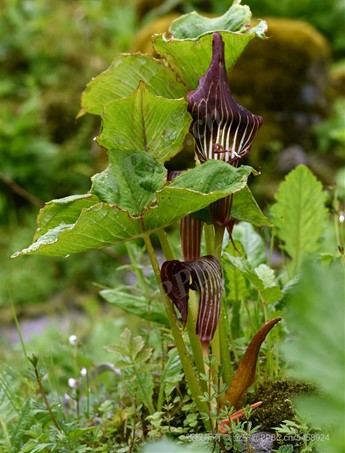
The young stems and leaves are also an important wild vegetable; they are usually sun-dried and stored for winter or major festivals. When there are no vegetables in winter, or at weddings and other large celebrations, the dried young shoots of Arisaema utile, Polygonatum and Pteridium are eaten as the main vegetables. Sometimes the Sherpa dig up tubers and plant them in their gardens so that they can be eaten at any time.
Arisaema utile is a multi-purpose plant. The Sherpa call the detoxification of its tubers “squeezing out the juice”: fresh tubers are processed into large granules, wrapped in rhododendron leaves and pressed under a heavy stone. After about 15 days, when no more juice flows out and a sour smell appears, detoxification is complete. Without protection, handling the tubers makes the hands swell, itch and even peel; nowadays people apply butter to prevent this.


Copyright © 2002-2025 Kunming Institute of Botany, Chinese Academy of Sciences. All rights reserved. [滇ICP备05000394号]
Address: 132 Lanhei Road, Kunming, Yunnan 650201, China Contact us
