| Ethnic group | Hani (Aini) |
|---|---|
| Location | Daka Old Village, Xishuangbanna, Yunnan |
| Plant composition | Adenosma buchneroides |
| Use category | Medicinal |
| Main use | Repelling mosquitoes and insects |
Flea grass (Adenosma buchneroides) is revered as a “sacred herb” by the Aini branch of the Hani people. It was discovered in the 1980s by the renowned Chinese ethnobotanist Prof. Pei Shengji during fieldwork on Aini swidden fallows in Xishuangbanna (see the habitat of flea grass below).
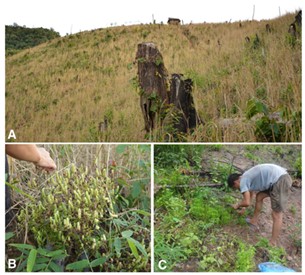
Local people tie flea grass into bundles and hang them in their rooms or spread them on their beds to drive away fleas, mosquitoes and other pests (see the folk uses of flea grass below).
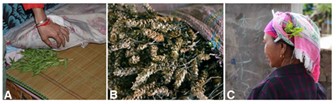
The village “public house” stands at the edge of the village, where unmarried young men and women gather at night to sing, dance, play and court. Annoying mosquitoes would spoil these evenings, and here flea grass comes into its own: girls tuck a bunch into the lace of their hats, and boys put a bunch in the large holes of their earlobes. Besides keeping mosquitoes away during courtship, this “love grass” also serves as an important marker of identity, showing that the wearers are Aini rather than members of another group.


Copyright © 2002-2025 Kunming Institute of Botany, Chinese Academy of Sciences. All rights reserved. [滇ICP备05000394号]
Address: 132 Lanhei Road, Kunming, Yunnan 650201, China Contact us
