| Ethnic group | Tibetan |
|---|---|
| Location | Gyirong Town, Tibet |
| Plant composition | Betula utilis;Himalayacalamus falconeri;Juniperus tibetica;Larix potaninii var. himalaica;Pinus roxburghii;Pinus wallichiana;Quercus semecarpifolia;Rhododendron arboreum;Salix trichocarpa;Berberis xanthophlaea;Fallopia denticulata;Rheum australe;Impatiens bicornuta;Impatiens falcifer;Impatiens scabrida;Impatiens sulcata |
| Use category | Tools |
| Main use | Making wooden bowls |
Wooden bowls are indispensable in Tibetan daily life and an important symbol of Tibetan culture. Gyirong Town in the Gyirong Valley is one of the most famous places in Tibet for making them; its craft was included in the second list of intangible cultural heritage of the Tibet Autonomous Region in 2007. Making a bowl involves selecting the material, rough shaping, turning, dyeing and lacquering.
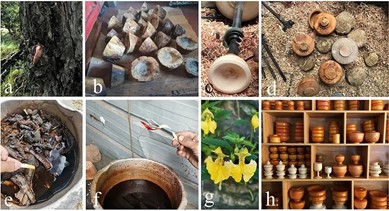
Bowl making in Gyirong. The trunks or roots of nine plants are used as raw material: Betula utilis, Himalayacalamus falconeri, Juniperus tibetica, Larix potaninii var. himalaica, Pinus roxburghii, Pinus wallichiana, Quercus semecarpifolia, Rhododendron arboreum and Salix trichocarpa. Himalayan birch (Betula utilis D. Don) is the most commonly used; local people consider bowls made from it to be light and resistant to cracking, and believe that eating from them is good for health. Bowls made from different parts of the same tree differ in quality: bowls made from burls are considered the best, and parents make birch-burl bowls as dowry for their children's weddings, wishing them a happy marriage. Three plants are used to dye the bowls: Berberis xanthophlaea, Fallopia denticulata and Rheum australe. The rhizome of Rheum australe or the root or bark of the barberry dyes the bowl yellow; the rhizomes of Rheum australe and Fallopia denticulata together dye it red, symbolizing good luck and happiness. Four plants are used to lacquer the bowls: Impatiens bicornuta, I. falcifer, I. scabrida and I. sulcata. The Tibetans of Gyirong use the seeds of these balsams to make a natural varnish: in early October they collect ripe seeds, dry and grind them and rub the resulting oil onto the dyed bowls, repeating the process at least three or four times. Traditionally, dead trees (killed by natural disasters) are regarded as the best material, and local people have rules on when to collect them — usually before the rainy season, to preserve the valuable grain patterns in the wood. This traditional management is similar in effect to thinning in modern forest management.


Copyright © 2002-2025 Kunming Institute of Botany, Chinese Academy of Sciences. All rights reserved. [滇ICP备05000394号]
Address: 132 Lanhei Road, Kunming, Yunnan 650201, China Contact us
